
 by
by 

Safe public water does not mean every water-related issue is solved before it reaches the home. Utilities are responsible for treatment, distribution, compliance, and public notification, but what comes out of a specific faucet can still be shaped by service lines, premise plumbing, fixtures, household conditions, and how people interpret risk once water enters the building. That is where public responsibility starts to overlap with household responsibility.
That overlap is one reason water discussions get confusing so quickly. Public officials often speak in system-wide terms. Residents experience water one tap at a time. Those are not always the same thing.
A utility can meet legal requirements and still serve a community with old infrastructure. A treatment plant can do its job and still leave households with questions about what happens in the last stretch between the main and the faucet. Public communication tends to compress all of that into one simple message: the system is safe or the system is not. Real life is usually more layered than that.
Quick Take
| Public system responsibility | Household-level reality |
|---|---|
| Treatment and disinfection | Water still travels through real infrastructure before it reaches the tap |
| Regulatory compliance | Compliance does not erase every building-specific condition |
| Monitoring and reporting | What matters to residents is what comes out of their faucet |
| Public notices and advisories | Households still have to decide how to respond |
| Infrastructure upgrades | Full replacement and local improvement often take years |
What Public Systems Are Responsible For
A public water system has serious obligations. At a minimum, those include:
- treating source water
- meeting applicable standards
- operating storage and distribution infrastructure
- monitoring water quality
- reporting violations or major issues
- issuing public notices when required
- maintaining and upgrading core parts of the system over time
That is a lot. It is also why the condition of public systems matters so much. Most people rely on those systems every day without thinking about them.
When the system works, it becomes invisible. Water arrives. Pressure is normal. Nothing smells off. There is no reason for the average household to think about treatment chemistry, monitoring schedules, or distribution integrity. That invisibility is part of what makes public responsibility easy to misunderstand. People often encounter the system only at the point of trust or doubt.
Where Household Responsibility Begins

The difficult part starts when the water leaves the broad language of compliance and enters a specific home.
Household-level conditions can involve:
- old service lines
- interior plumbing materials
- stagnant water in low-use fixtures
- building-specific maintenance issues
- fixtures or faucets that influence what comes out at the point of use
- questions about filtration, testing, or follow-up after a local concern
This does not mean public systems stop mattering once water reaches a building. It means public systems are not the only variable anymore.
That distinction is easy to miss. Many residents hear a system-level reassurance and assume it answers every household-level concern. In some cases it does. In others, it only answers part of the question.
Why the Line Feels So Blurry
The boundary between public responsibility and household responsibility is not always obvious because people experience water through results, not through governance diagrams.
A resident does not naturally think in categories like:
- utility-owned infrastructure
- service connection
- premise plumbing
- fixture-level variation
- building-level risk
They think in simpler terms:
- Is the water safe?
- Does it taste normal?
- Should I trust it?
- Do I need to do anything?
That is why the line feels blurry. Institutions are organized one way. Households experience the issue another way.
It also does not help that trust is uneven. In places where public messaging has been late, incomplete, or overly polished in the past, residents are more likely to assume that official reassurance leaves something out. Even when the utility is technically correct, confidence may still lag behind.
That uncertainty is one reason CDC guidance on tap water safety draws a distinction between meeting public-water standards and how water may actually be used in different household situations.
Public Compliance Is Not the Same as Household Certainty
This is the point that gets lost most often.
A system can be compliant and a household can still feel uncertain.
That can happen because:
- the issue is historical rather than current
- infrastructure work is still underway
- residents do not know what parts of the system have or have not been updated
- plumbing inside the home remains a question
- trust was damaged earlier and never fully restored
- communication answered the legal question but not the practical one
This is not an argument against public systems. It is an argument for precision.
System-wide safety and household-level certainty are related, but they are not perfectly interchangeable. A serious public conversation should be able to hold both ideas at once.
The Practical Question Residents Actually Ask
Most people do not want a lecture on jurisdiction. They want to know where responsibility becomes personal.
A more useful version of the question is:
What is the system responsible for, and what should a household still understand, verify, or maintain on its own?
That is where many public explanations fall short. They answer the compliance issue without fully addressing the practical one.
A Better Way to Explain the Divide
Public systems generally own:
- treatment
- broad distribution
- compliance reporting
- notices
- large-scale infrastructure decisions
Households still have to think about:
- the condition of their internal plumbing
- building-specific issues
- whether local concerns change how they use or test water
- whether additional action is needed after trust has been shaken
That does not mean every household problem requires household treatment. It means households live at the end of a chain, and the end of the chain is where broad public language becomes personal experience.
Why Evidence Matters Here
This is where household-level data can become useful.
A system-wide statement tells residents what is true at the level of the public utility. A household-level result can help illustrate what people are actually dealing with at the point of use.
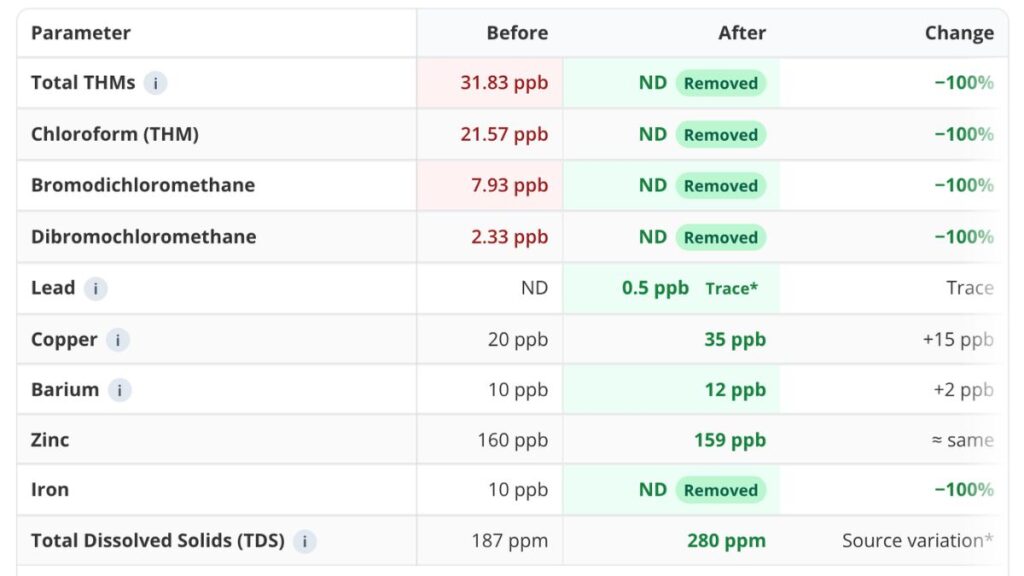
Used carefully, that kind of example can help explain why some residents continue to ask questions even after they hear that the broader system is in compliance. It makes the abstract point more concrete: what matters to a household is not only what the system is designed to deliver, but what actually reaches the faucet under real conditions.
What Households Should Actually Take Away
The goal is not to turn every public water issue into a private burden. It is to understand the boundary more clearly.
Households should not assume:
- public compliance answers every building-level question
- every concern requires panic
- every uncertainty means the entire public system failed
But they also should not assume:
- system-level language automatically resolves every point-of-use concern
- infrastructure conditions are identical everywhere
- trust repairs itself the moment officials say the issue is under control
A better public understanding would treat these as connected layers rather than competing stories.
The Bottom Line
Public water responsibility does not end at treatment, but it does not fully govern what happens inside every building either. Utilities are responsible for treatment, compliance, monitoring, and distribution. Households live with the final outcome at the point of use, where plumbing, service conditions, and local context can still shape experience.
That is why the line between public responsibility and household responsibility matters. It helps explain why official reassurance can be accurate and still leave residents with practical questions. It helps explain why trust can stay fragile even when the system improves. And it helps move the discussion away from false choices between “everything is fine” and “nothing is safe.”
The more useful view is simpler: public systems matter enormously, but what reaches the tap is still the result of a chain. Understanding where that chain changes hands is the first step toward a more honest conversation.

Leave a Reply